Scandinavian Modern
Early 1950s Ercol Elm Drop-Leaf Dining Table | Lucian R. Ercolani
Early 1950s Ercol Elm Drop-Leaf Dining Table | Lucian R. Ercolani
Couldn't load pickup availability
Ok An early Ercol drop-leaf dining table, most likely designed by Lucian R. Ercolani and dating from the early 1950s.
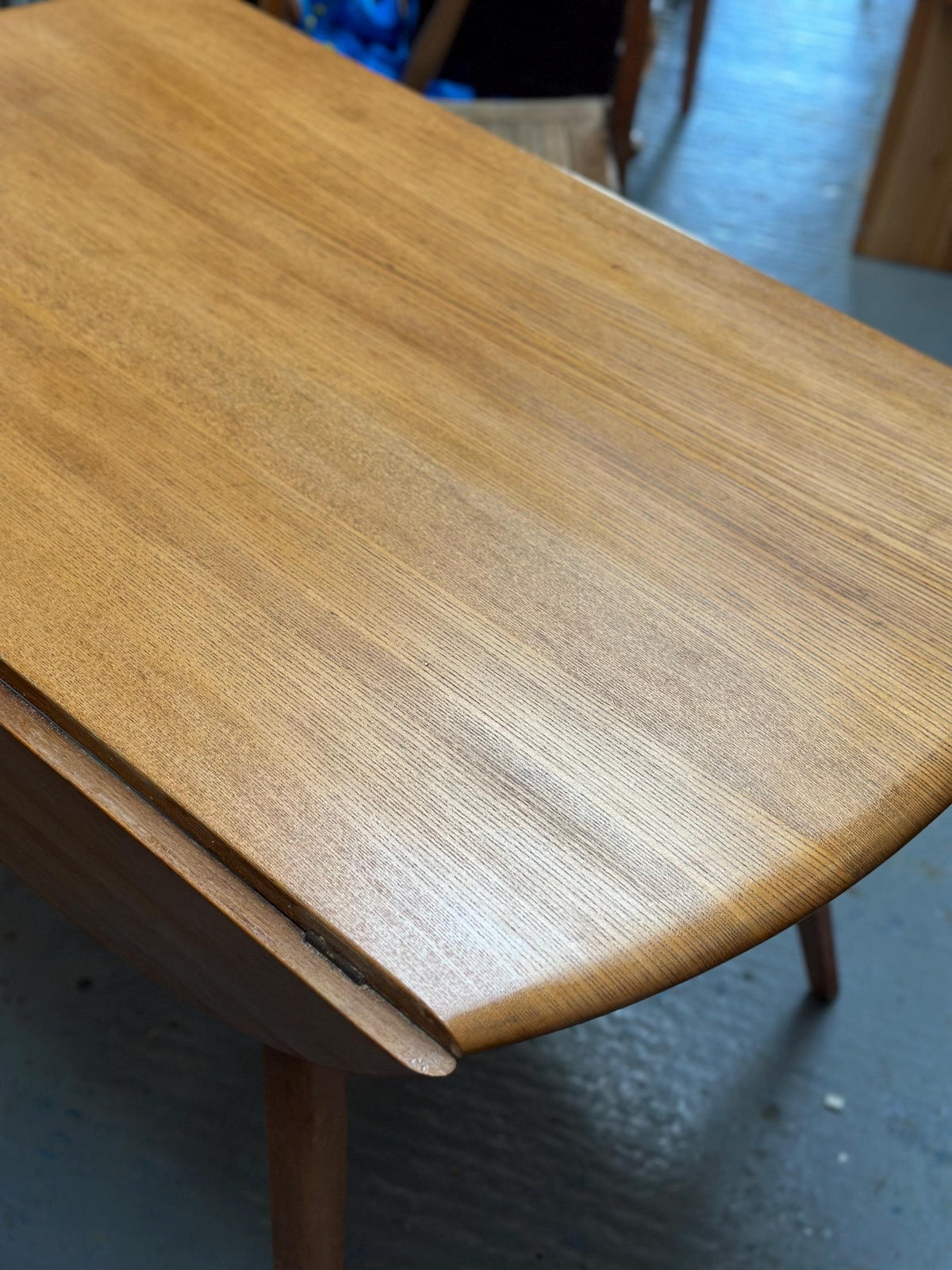
The table belongs to the formative period of Ercol’s post-war modernism. Its design is defined by an accentuated simplicity: a beautifully figured solid elm top, gently rounded edge, tapered legs and an economical structure with virtually nothing superfluous.
When opened, the two leaves create an almost circular dining surface measuring 115 × 113 cm — a particularly pleasing and sociable proportion for four people. The leaves are supported by steel rods which slide through the underframe, a remarkably simple piece of engineering that makes the table exceptionally rigid when fully extended.
The likely date of manufacture, simplicity of construction and emerging Ercol aesthetic all support an attribution to Lucian R. Ercolani, whose post-war work helped establish a distinctly British interpretation of modern furniture: traditional materials reconciled with the possibilities of modern serial manufacture.
This example retains particularly useful evidence of its early manufacture. Beneath the table is an early “THIS IS AN ERCOL PRODUCTION” factory label, together with a separate ink-stamped production or inspection number and period cross-head fixings.
The table carries none of the British Standards identification found on later Ercol production. The relevant BS 1960 standard for domestic wooden tables appeared in 1953. Its absence cannot date the table precisely, but considered alongside the early factory label, construction and hardware, the evidence is consistent with manufacture in the early 1950s.
Conservation
Furniture such as this is now an important part of British design history, and our approach to restoration reflects that. The aim is not to return a seventy-year-old table to an approximation of newness, but to preserve as much of the original object — and the evidence of its life — as possible.
The factory finish had deteriorated to the point where intervention was necessary. It was carefully removed without aggressively sanding the elm beneath. Sanding away every mark would also remove material, soften edges and gradually erase the evidence that makes an early piece such as this historically interesting. Small marks, changes in tone and traces of previous use have therefore been retained.
The final finish has deliberately been kept tactile. Rather than burying the elm beneath a thick synthetic varnish — as, ironically, Ercol originally did — the surface allows you to feel the grain of the timber beneath your hand. The extraordinary figuring of the elm can now be both seen and felt.
It is anew but not new: conserved for continued use without attempting to erase the decades that came before.
Why it works
There is an almost reductive quality to the design. Four tapered legs, a near-circular top and a simple mechanical solution are sufficient.
That economy is both practical and aesthetic. The structure recedes, leaving the elm itself to provide the visual character. Its grain is not decoration applied to the object; it is the decoration.
This is an early expression of what would become unmistakably Ercol — proportion rather than ornament, traditional timber interpreted through modern manufacture.
Compact when closed, generous and exceptionally stable when opened, it remains a remarkably usable piece of early British modernism more than seventy years after it was made.
Dimensions: Fully extended: 115 × 113 cm. Closed: 61.5 x 113cm Height: 72cm.
Share